JDK vs JRE vs JVM
JDK vs JRE vs JVM
In Java, the terms JDK, JRE, and JVM are foundational concepts. Every Java developer uses them daily, often without thinking deeply about how they interact. However, a clear understanding of these three components is essential to truly understand how Java programs are developed, compiled, and executed.
Although they are closely related, JDK, JRE, and JVM are not the same, and each has a distinct responsibility in the Java ecosystem.
JVM (Java Virtual Machine)
The JVM is the heart of Java’s platform independence.
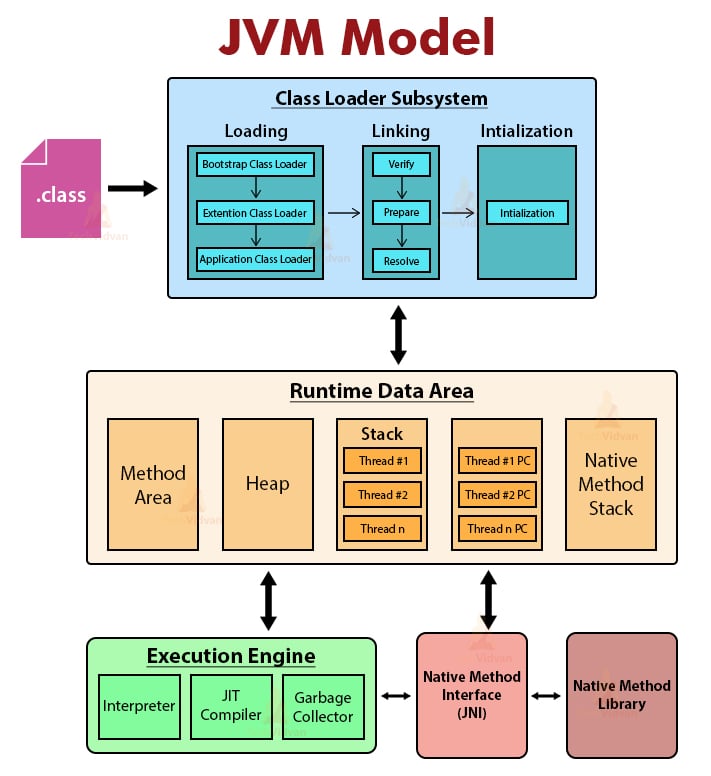
The JVM is a virtual execution environment that runs Java bytecode. Java programs never interact directly with the operating system. Instead, the JVM acts as an intermediary layer between Java applications and the OS.
Core responsibilities of JVM
- Loads compiled
.classfiles - Verifies bytecode for security and correctness
- Converts bytecode into native machine instructions
- Manages memory allocation and deallocation
- Performs garbage collection
- Handles runtime exceptions
The JVM is platform dependent, meaning each operating system has its own JVM implementation. However, Java bytecode remains the same across platforms.
This design is the reason Java follows the principle:
Write Once, Run Anywhere
JRE (Java Runtime Environment)
The JRE provides everything required to run Java applications, but nothing required to create them.
The JRE includes:
- JVM
- Core Java class libraries
- Supporting runtime files
When a user runs a Java application, the JRE ensures that:
- Required classes are available
- The JVM can execute the bytecode
- Runtime dependencies are resolved
The JRE cannot compile Java code. It does not include the Java compiler.
When JRE is used
- Running desktop Java applications
- Executing
.jarfiles - Using Java-based tools and software
If a system is only meant to execute Java programs, installing JRE is sufficient.
JDK (Java Development Kit)
The JDK is a complete toolkit for Java developers.
It includes:
- JRE
- Java compiler (
javac) - Debugging tools
- Packaging tools
- Documentation generators
The JDK allows developers to:
- Write Java source code
- Compile
.javafiles into.classfiles - Debug applications
- Package applications for distribution
Common tools inside JDK
javac– compiles Java source codejava– launches the JVM to run programsjavadoc– generates API documentationjar– packages applications into archives
Without JDK, Java development is not possible.
Hierarchical Relationship Explained Simply
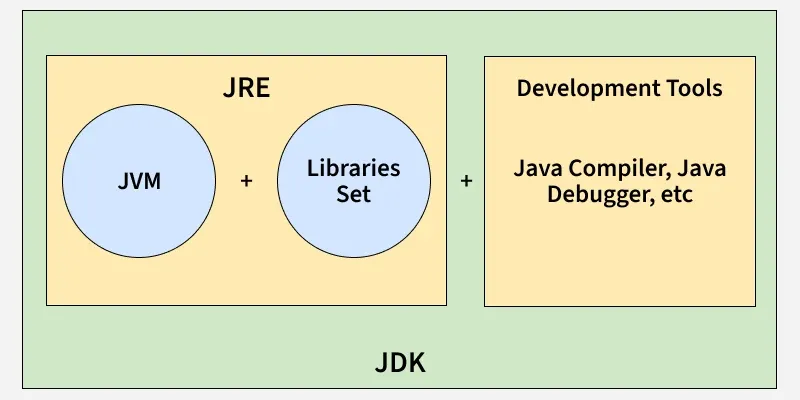
The relationship between these three components is nested, not parallel.
JDK
 └── JRE
      └── JVM
- JVM executes bytecode
- JRE provides the runtime environment
- JDK provides development tools
Each layer builds upon the one below it.
Practical Execution Flow Example
On a developer’s system
- Java source code is written (
.java) javaccompiles it into bytecode (.class)- JVM executes the bytecode
- JRE provides required libraries
This entire process requires JDK.
On an end user’s system
- User runs a Java application
- JVM executes bytecode
- JRE provides runtime support
Only JRE is required here.
Why JVM Is the Most Critical Component
The JVM provides features that define Java’s identity:
- Platform independence
- Memory safety
- Automatic garbage collection
- Runtime optimization through JIT compilation
- Strong security enforcement
Because of these capabilities, many other programming languages also run on the JVM, making it a powerful and mature execution platform.
Common Confusions Cleared Clearly
- JDK is not just a compiler
It is a complete development environment. - JRE is not optional for execution
Every Java program needs JRE to run. - JVM alone cannot run applications
It needs libraries provided by JRE.
Understanding these distinctions prevents configuration and deployment mistakes.
Why This Separation Exists
Java intentionally separates development and execution environments to:
- Reduce installation size for end users
- Improve security
- Allow independent JVM improvements
- Support long-term application stability
This modular design contributes to Java’s success in enterprise environments.
Conclusion
JDK, JRE, and JVM form the backbone of Java’s execution model. The JVM executes Java bytecode, the JRE provides the runtime environment, and the JDK provides development tools. Their clear separation ensures portability, security, and scalability. Understanding how they interact builds a strong foundation for mastering Java and working confidently with real-world Java applications.