Type Casting in Java Explained with Examples
Type Casting in Java
Type casting in Java is one of the most fundamental yet misunderstood concepts. Many beginners see type casting as just a syntax rule, but in reality, it is about how Java controls data movement, memory safety, and precision.
Java is a strongly typed language, which means it does not allow data of one type to be freely assigned to another type unless the rules are strictly followed. These rules exist to prevent data loss, unexpected behavior, and runtime errors.
This post explains type casting in Java completely, step by step, with real-life examples, code examples, reasons, rules, limitations, and common mistakes.
What Is Type Casting in Java
Type casting means converting a value from one data type to another data type.
Example:
int a = 10;
double b = a;
Here, an int value is converted into a double.
Type casting is required when:
- Assigning one data type to another
- Performing calculations involving different data types
- Storing values in smaller or larger memory types
Why Type Casting Is Needed in Java
Java uses type casting to ensure:
- Data safety
- Controlled memory usage
- Predictable calculations
- No silent data loss
Without type casting rules:
- Decimal values could disappear silently
- Large numbers could overflow
- Boolean logic could break numeric operations
Java forces you to be explicit whenever there is a risk.
Classification of Type Casting in Java
Java supports two main types of type casting:
- Widening Type Casting (Implicit Casting)
- Narrowing Type Casting (Explicit Casting)
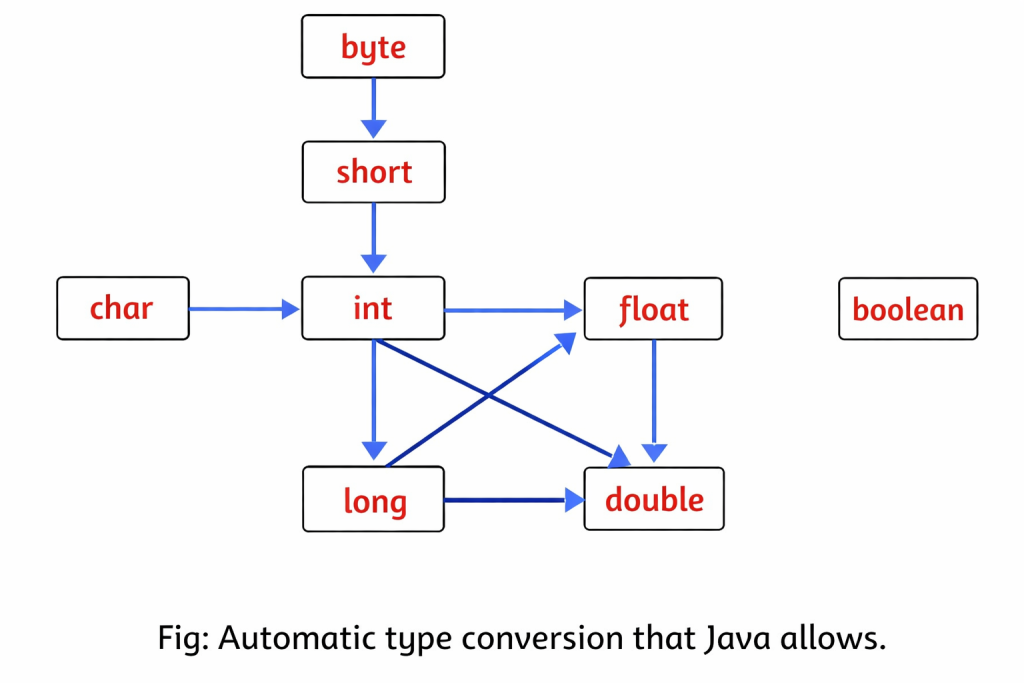
1️⃣ Widening Type Casting (Implicit Casting)
What Is Widening Casting
Widening casting means converting a smaller data type into a larger data type.
This type of casting is done automatically by Java because:
- No data is lost
- The destination type can fully hold the source value
Order of Widening Casting
byte → short → int → long → float → double
Example of Widening Casting
int marks = 85;
double result = marks;
Here:
marksis anintresultis adouble- Java automatically converts
85to85.0
Real-Life Example (Widening Casting)
👉 Example: Small Bottle to Big Bottle
Imagine:
- You have 1 liter of water
- You pour it into a 5-liter bottle
Nothing is lost.
Everything fits easily.
This is widening casting:
- Small data → larger container
- Safe and automatic
More Examples
byte b = 10;
int i = b;

long l = i;
float f = l;
double d = f;
All conversions happen automatically.
Why Java Allows Widening Automatically
Because:
- No precision loss
- No overflow
- No unexpected results
Java trusts widening conversions.
2️⃣ Narrowing Type Casting (Explicit Casting)
What Is Narrowing Casting
Narrowing casting means converting a larger data type into a smaller data type.
This is not done automatically because:
- Data loss can occur
- Decimal part may be removed
- Value may overflow
Java requires explicit instruction from the developer.
Example of Narrowing Casting
double price = 99.99;
int amount = (int) price;
Output:
99
The decimal part is lost.
Real-Life Example (Narrowing Casting)
👉 Example: Big Container to Small Cup
- You have 2 liters of water
- You try to pour it into a 1-liter cup
Some water will spill.
That spillage is data loss, which is why Java forces explicit casting.
Another Example
int value = 130;
byte b = (byte) value;
Output:
-126
Why?
byterange is -128 to 127- Value overflows and wraps around
Why Java Forces Explicit Casting
Java wants the developer to say:
“I understand data loss may happen, and I accept it.”
This prevents accidental bugs.
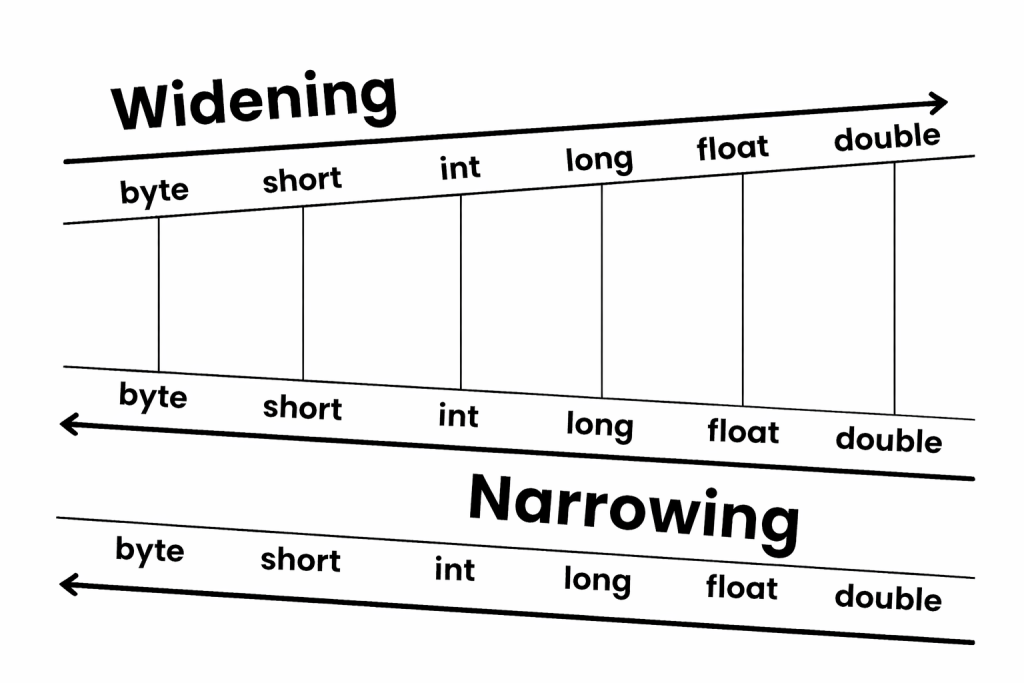
Type Casting Between Primitive Data Types
| From | To | Casting Required |
|---|---|---|
| int | double | No |
| double | int | Yes |
| byte | int | No |
| int | byte | Yes |
| char | int | No |
| int | char | Yes |
Type Casting with char
char to int
char ch = 'A';
int ascii = ch;
Output:
65
Because char stores Unicode values.
int to char
int code = 66;
char letter = (char) code;
Output:
B
Real-Life Example
👉 Example: Character Codes
- Computers store characters as numbers
- Casting allows conversion between human-readable and machine-readable formats
Type Casting in Expressions
Java automatically promotes smaller data types during expressions.
byte a = 10;
byte b = 20;
int result = a + b;
Why result is int?
- Java promotes operands to
intbefore calculation
Type Casting with float and double
int a = 5;
int b = 2;

double result = (double) a / b;
Output:
2.5
Without casting:
2
Type Casting with boolean (Important Rule)
🚫 boolean cannot be cast to or from any numeric type
Invalid:
int x = (int) true; // ❌
Java keeps boolean logic completely separate for safety.
Type Casting with Reference Types (Basic Concept)
Reference type casting applies to objects and inheritance.
Animal a = new Dog(); // Upcasting
Dog d = (Dog) a;      // Downcasting
This works only when there is an IS-A relationship.
(Deep explanation usually covered with inheritance.)
Common Beginner Mistakes
- Assuming Java rounds values (it truncates)
- Forgetting to cast in division
- Expecting automatic narrowing
- Ignoring overflow behavior
- Confusing widening and narrowing
These mistakes lead to silent logic errors.
When to Use Type Casting (Best Practices)
- Use widening casting freely
- Avoid narrowing unless absolutely required
- Always validate values before narrowing
- Use
doublefor calculations by default - Be cautious with byte and short
Why Type Casting Matters in Real Projects
In real applications:
- Financial calculations demand precision
- Sensor data requires controlled conversion
- APIs return mixed data types
- Memory optimization needs careful casting
Incorrect casting can cause:
- Financial loss
- Data corruption
- Hidden bugs
Conclusion
Type casting in Java is not just a syntax feature; it is a core safety mechanism. Java allows automatic conversion only when it is safe and forces explicit casting when data loss is possible. Understanding widening and narrowing casting with real-life analogies helps developers write correct, predictable, and professional Java code. Mastery of type casting is essential for working with calculations, APIs, memory optimization, and real-world Java applications.